Spatial
Information Architecture Laboratory
School of Architecture + Design
RMIT University
Melbourne, Australia |
|
| Grant.Dunlop@rmit.edu.au |
|
TITLE:
Paramorphs: An Alternative Generative
System
ABSTRACT:
The ongoing series of Paramorph projects provides an interesting alternative
to the application of a 'pure' approach to generative processes within the context
of architectural design and practice. These projects take advantage of the potential
of parametric modelling or associative geometry software to construct variable
geometric computer models, from which a wide range of formal possibilities may
be generated. The models that are produced differ from conventional models,
possessing an underlying structure and logic that may then be iteratively explored.
They are not so much forms themselves, but the possibility of form. Such an
approach to generative design, where the code takes the form of a geometric
construction rather than the abstraction of a computer program, is one that
is, arguably, more suited to the nature and demands of architecture and its
design. This technique provides the opportunity for direct visual control and
engagement with the model, something which current design thinking and practice
within architecture favours.
 paramorphs [fig1] (click
to enlarge)
paramorphs [fig1] (click
to enlarge) |
As a method for developing geometric
computer models, parametric modeling differs greatly from traditional
methods. It may also be viewed as occupying an intermediate position between
conventional modeling and the generation of architectural form through
the use of genetic algorithms and the like. The independence of 'code'
and 'product' present in many examples of generative processes is avoided
in parametric design.
|
With a generative approach to creative production
it is possible for there to be a clear distinction between what is generated
and what generates; between the code and the resultant objects. With a parametric
or associative geometry approach, the underlying structure or system (or code)
is manually constructed and forms an integral component to what may then be
produced.
Alternatively, the structure of a parametric
model, in the form of the various geometric entities and their associated relationships,
may be seen as performing the same function as the programmed code in a 'pure'
generative system. The difference is obviously in the language in which the
structure is produced; its level of abstraction (e.g. computer programming code,
C++, versus geometric modelling actions and elements), and the manner in which
the structure is produced (e.g. computer programming, compiling and execution,
versus direct or manual computer modelling).
In this particular case, the 'generative
code' is the result of the ordered recording of a number of 'design acts' –
a construction history – and which is integral to the resultant model.
Rather than explicitly defining a single geometric model (or description, as
required by traditional means), parametric design offers the possibility of
form – the object is defined by what it could be rather than what it specifically
is.
Latent within the base model is a family
of forms – related but different – which may then be re-visited and
explored further. Parametric design is an approach foreign to a purely accidental
attitude to creative production. The freedom and potential of the model is dependent
upon the schema adopted at the outset and the nature of the geometric entities
and their relationships chosen to construct the model. It is predicated upon
having a developed understanding of the design to the extent that its constituent
parameters can be recorded historically along with relationships between geometrical
entities. The underlying parametric structure is carefully constructed so as
to be able accommodate as wide a range of possible variations. The direction
of exploration and the variations generated may be either directed or free.
A directed approach may be adopted when an existing design has been developed
to the extent where the primary consideration is the development or resolution
of that concept, carried out through a highly resolved and specialized model.
A free exploration would typically generate a wide range of forms from the original
model, testing the formal potential of that schema.
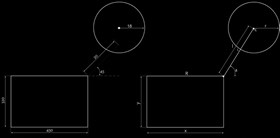
| In the illustrated example, a circle
'C' of radius 'r' can be linked by a line 'L' of length 'l' between the
circle's centre down to the top right hand corner of a rectangle 'R' measuring
'x' by 'y' lying below and to the left of the circle. 'C' is an 'object',
and 'c' is a parameter [fig. 1]. In a carefully considered design, a so-called
explicit design, parameters have declared values. In almost all CAD packages
the design is explicit, regardless of how the software user might have produced
it. 'Grip points' give the impression of parametric variability – which
to an extent they are. The user 'grips' the centre of 'C' at 'c', and moves
it with the mouse to a new position. But the line 'L' remains in place in
its original position. If the geometry is associated the situation changes
quite distinctly. If entity 'C' for example moves through the redefinition
of the position of 'c', the end of line 'L' whose end is linked to 'c' moves
with it while remaining attached to the rectangle [fig. 2]. |
paramorphs [fig2] (click
to enlarge)
|
The precursor to Paramorphs I and II, was
a variable surface controlled by a series of spline curves, which were themselves
defined by a grid of endpoints from a number of variable lines. This simple
exercise was a semi-ironic response to the willful exploitation and abuse of
complex modeling and animation software by a number of architects at that time.
Paramorph I was a natural continuation of that earlier work; moving from surface
to volume, with an accompanying increase in complexity. The intention of the
'dumb box' was to begin to explore the potential of such an approach for the
generation of complex architectural form, and what opportunities existed for
employing such a technique as a design tool at an early stage.
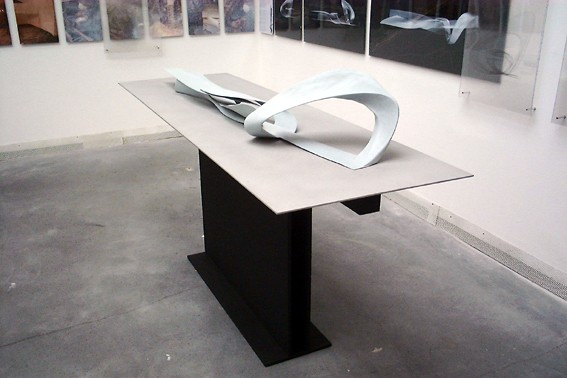 |
Paramorph II, or the Sutton Place Gateway
to the South Bank, was a collaborative project carried out with dECOi architect(e)s
in Paris, France. The primary requirement for this project was to provide
accurate and meaningful information regarding the geometric nature of the
design materials. This involved being able to capture and recreate the design
intent and formal or gestural nature of the early design work, but within
a highly controlled environment. The underlying geometry of the original
models is recorded and transposed to the "parametric tube" constructed
for the project. From this a number of surfacing regimes (such as free form
NURBS, facetted or ruled surfaces) may be extracted. |
This method of working accommodates some
of the common difficulties of such a dispersed and intensive collaboration.
With the base "parametric tube" constructed, it is then possible to
'drive' the model using text based command scripts which alter the values of
the appropriate parametric values and relationships and allow the model to be
reconfigured in the desired manner.
Through the Paramorph experiments the parametric
approach has proved its metal both as a framework for a very free generative
tool and as a highly controlled means of design refinement and precise geometrical
description for construction. Thus it holds out promise for future exploration
into different ways of setting up the underlying parametric structure, and for
beginning to exploit the latent potential of these forms through their integration
or connection to other systems of control or generation. Perhaps these Paramorphs
may be driven by other independent but connected generative tools and systems,
responding to their various inputs or stimuli, including those of a 'real' architectural
nature.
ABOUT:
The Spatial Information Architecture Laboratory draws on students, academic
staff, and industry led researchers towards design enquiry, speculation, and
realisation in three core areas, each servicing the other:
- design philosophy;
- total design culture; and
- interdisciplinary design practice.
Activities that can only take place within
an academic environment are encouraged within the laboratory in the context
of, and drawing intellectual comfort from, practical relationships with industry
and practice.

aegis sequence (at CEBIT)
 CONTRIBUTOR
 invited speaker
  speaker
 }
}
 }
}

